Complete Guide to 3D Printing Materials (FDM Filaments)

3D printing has evolved rapidly, and one of the most critical factors determining print quality, durability, and application suitability is the material (filament) you choose. In FDM (Fused Deposition Modeling) printing, different filaments offer vastly different mechanical, thermal, and aesthetic properties.
This guide breaks down the most commonly used 3D printing filaments, their characteristics, advantages, disadvantages, and real-world applications, helping you or your customers make informed decisions.
1. PLA (Polylactic Acid)
Overview
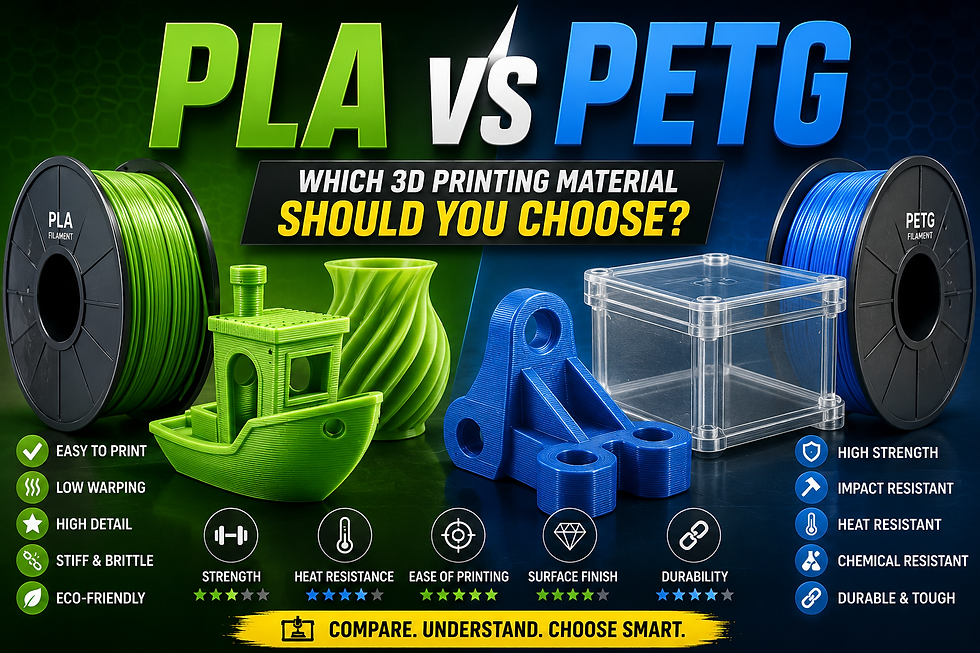
PLA is the most widely used filament in 3D printing. It is biodegradable, easy to print, and ideal for beginners and visual prototypes.
Key Characteristics
Low printing temperature (180–220°C)
Minimal warping
Biodegradable (derived from corn starch)
Good surface finish
Brittle compared to other materials
Advantages
Extremely easy to print (low failure rate)
No heated bed required (optional)
Wide range of colors and finishes
Environmentally friendly compared to petroleum-based plastics
Disadvantages
Low heat resistance (softens around 60°C)
Brittle (not suitable for mechanical stress)
Poor UV resistance
Typical Applications
Prototypes
Decorative items
Models and figurines
Low-stress components
Educational prints
2. ABS (Acrylonitrile Butadiene Styrene)

Overview
ABS is a strong, durable plastic commonly used in industrial applications. It is the same material used in LEGO bricks.
Key Characteristics
Printing temperature: 220–260°C
Requires heated bed
High strength and impact resistance
Can be acetone-smoothed
Advantages
Strong and durable
Heat resistant (~100°C)
Suitable for functional parts
Post-processing (acetone smoothing) possible
Disadvantages
Warping and cracking issues
Requires enclosed printer
Emits fumes (needs ventilation)
Harder to print than PLA
Typical Applications
Automotive parts
Functional prototypes
Mechanical housings
Tools and enclosures
3. PETG (Polyethylene Terephthalate Glycol)
Overview
PETG combines the ease of PLA with the strength of ABS, making it one of the most versatile filaments.
Key Characteristics
Printing temperature: 220–250°C
Excellent layer adhesion
Slight flexibility
Chemical resistance
Advantages
Strong and impact-resistant
Less warping than ABS
Good chemical and moisture resistance
Food-safe variants available
Disadvantages
Stringing issues during printing
Surface scratches easily
Less rigid than PLA
Typical Applications
Mechanical parts
Water-resistant components
Containers and bottles
Outdoor applications
4. TPU (Thermoplastic Polyurethane – Flexible Filament)

Overview
TPU is a flexible, rubber-like filament used for parts requiring elasticity.
Key Characteristics
Printing temperature: 210–240°C
Highly flexible (elastic)
Good abrasion resistance
Shock absorbing
Advantages
Flexible and durable
Resistant to wear and tear
Excellent for impact absorption
Good grip properties
Disadvantages
Difficult to print (requires slow speeds)
Needs direct drive extruder (ideally)
Can cause feeding issues
Typical Applications
Phone cases
Seals and gaskets
Wearables
Vibration dampeners
5. Nylon (Polyamide)
Overview
Nylon is a high-performance engineering filament known for its strength, flexibility, and durability.
Key Characteristics
Printing temperature: 240–270°C
High strength and toughness
Hygroscopic (absorbs moisture)
Slight flexibility
Advantages
Excellent mechanical strength
High wear resistance
Good chemical resistance
Ideal for moving parts
Disadvantages
Requires drying before printing
Warping issues
Needs high-temperature setup
Difficult for beginners
Typical Applications
Gears and bearings
Functional prototypes
Industrial components
Hinges and joints
6. Carbon Fiber Reinforced Filaments
Overview
These filaments combine base materials (PLA, PETG, Nylon) with carbon fibers to improve strength and stiffness.
Key Characteristics
Lightweight and rigid
Matte surface finish
Reduced warping
Abrasive (wears nozzle)
Advantages
High stiffness-to-weight ratio
Professional surface finish
Improved dimensional stability
Less shrinkage
Disadvantages
Requires hardened steel nozzle
More expensive
Brittle depending on base material
Typical Applications
Aerospace components
Automotive parts
Structural components
High-end prototypes
7. ASA (Acrylonitrile Styrene Acrylate)
Overview
ASA is similar to ABS but designed for outdoor use with superior UV resistance.
Key Characteristics
UV resistant
Weather resistant
Strong and durable
Requires enclosure
Advantages
Excellent outdoor durability
Better UV resistance than ABS
Good mechanical strength
Smooth finish
Disadvantages
Warping similar to ABS
Requires controlled environment
Emits fumes
Typical Applications
Outdoor enclosures
Automotive exterior parts
Signage
Garden fixtures
Material Selection Strategy (Key Insight for Customers)
Choosing the right filament depends on three critical engineering factors:
1. Mechanical Requirements
Load-bearing → Nylon / PETG / ABS
Flexible → TPU
Decorative → PLA
2. Environmental Conditions
Outdoor → ASA / PETG
High temperature → ABS / Nylon
Moisture exposure → PETG
3. Print Complexity
Beginner → PLA
Intermediate → PETG
Advanced → Nylon / ABS / CF
Conclusion
Understanding filament materials is essential for maximizing the performance and reliability of your 3D printed parts. Each material offers a unique balance of printability, strength, flexibility, and environmental resistance.
For a professional 3D printing service (like yours), offering material guidance alongside printing services significantly increases customer trust and project success rates.


Comments