PLA Filament for 3D Printing


Properties, Variations, Applications & Specifications
Introduction
Polylactic Acid (PLA) is the most widely used filament in FDM/FFF 3D printing. Manufactured primarily from renewable plant-based resources such as corn starch and sugarcane, PLA is known for its excellent printability, smooth surface finish, low warping behavior, and wide material availability.
Due to its ease of use and reliable performance, PLA is commonly used for prototyping, decorative products, educational projects, consumer goods, and general-purpose additive manufacturing.
Technical Specifications
Property | Typical Value |
Material Type | Biopolymer Thermoplastic |
Printing Technology | FDM / FFF |
Nozzle Temperature | 190–220°C |
Bed Temperature | 0–60°C |
Density | ~1.24 g/cm³ |
Glass Transition Temperature | ~60°C |
Melting Temperature | 150–180°C |
Shrinkage | Very Low |
Odor During Printing | Minimal |
Print Difficulty | Easy |
Mechanical Properties
Property | Typical Range |
Tensile Strength | 40–70 MPa |
Young’s Modulus | 3.5–4 GPa |
Elongation at Break | 4–10% |
Impact Resistance | Moderate to Low |
Rigidity | High |
Flexibility | Low |
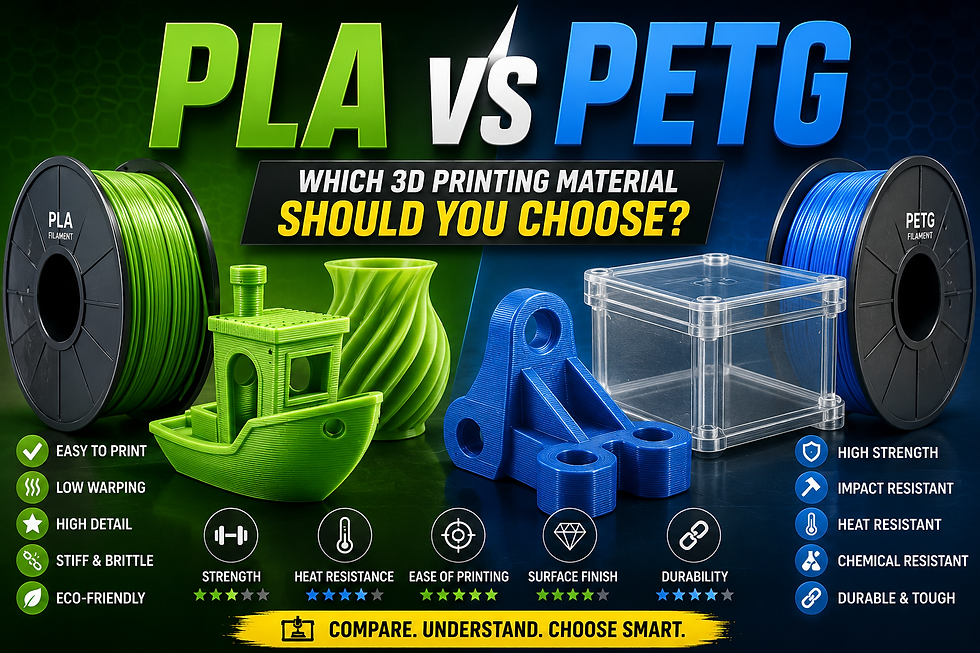
PLA provides good rigidity and dimensional stability but is less impact resistant compared to materials such as PETG or ABS.
Advantages & Limitations
Advantages | Limitations |
Easy to print | Low heat resistance |
Excellent surface finish | Can become brittle |
Low warping | Limited outdoor durability |
Minimal odor | Lower impact resistance |
Wide color selection | Softens above 55–60°C |
Affordable material cost | Not ideal for high-load parts |
Types of PLA Filament
Standard PLA
Feature | Description |
Printability | Excellent |
Surface Finish | Smooth |
Cost | Economical |
Best For | Decorative models, prototypes, educational use |
PLA+
Feature | Description |
Strength | Improved |
Toughness | Higher than standard PLA |
Layer Adhesion | Better |
Best For | Functional parts, prototypes, brackets |
Silk PLA
Feature | Description |
Finish | Glossy / Metallic |
Appearance | Reflective |
Mechanical Strength | Slightly lower |
Best For | Decorative prints, display models, cosplay |
Matte PLA
Feature | Description |
Surface Finish | Non-reflective |
Layer Visibility | Reduced |
Appearance | Professional |
Best For | Product mockups, architecture, presentation models |
Carbon Fiber PLA
Feature | Description |
Reinforcement | Chopped carbon fiber |
Stiffness | Increased |
Weight | Lightweight |
Nozzle Requirement | Hardened steel |
Best For | Engineering parts, drone frames, RC models |
Wood PLA
Feature | Description |
Composition | PLA with wood particles |
Texture | Wood-like |
Post Processing | Sandable & paintable |
Recommended Nozzle | 0.5–0.6 mm |
Best For | Decorative products, furniture models |
Glow-in-the-Dark PLA
Feature | Description |
Additive | Phosphorescent particles |
Visual Effect | Glows after UV exposure |
Nozzle Wear | High |
Recommended Nozzle | Hardened steel |
PLA Color Options
Standard Colors | Specialty Finishes |
Black | Silk |
White | Matte |
Gray | Marble |
Blue | Metallic |
Red | Rainbow |
Green | Transparent |
Yellow | Glow-in-the-dark |
Orange | Galaxy sparkle |
Recommended Printing Settings
Setting | Recommended Range |
Nozzle Temperature | 200–210°C |
Bed Temperature | 50–60°C |
Cooling Fan | 80–100% |
Print Speed | 40–80 mm/s |
Layer Height | 0.12–0.28 mm |
Common Applications
Industry / Use | Application |
Prototyping | Concept models |
Consumer Products | Organizers, enclosures |
Decorative Printing | Statues, vases, props |
Education | STEM projects |
Architecture | Scale models |
Engineering | Visual prototypes |
Storage & Moisture Control
PLA absorbs moisture over time, which can negatively affect print quality.
Moisture Symptoms | Recommended Solution |
Stringing | Dry filament |
Rough surfaces | Airtight storage |
Weak layers | Use silica gel |
Popping sounds | Filament dry box |
Recommended PLA Brands
PLA Compared to Other Filaments
Material | Printability | Heat Resistance | Strength | Difficulty |
PLA | Excellent | Low | Moderate | Easy |
PETG | Good | Moderate | Good | Medium |
ABS | Moderate | High | Good | Medium |
Nylon | Difficult | High | Excellent | Advanced |
Conclusion
PLA remains the industry-standard material for desktop FDM 3D printing due to its excellent print quality, low warping behavior, broad material availability, and ease of use. With modern variations such as PLA+, Silk PLA, Matte PLA, and Carbon Fiber PLA, the material now supports applications ranging from decorative products to engineering prototypes and functional components.
do a deep search and make this article readable and convenient to find the required details.


Comments