PLA vs PETG: Which 3D Printing Material Should You Choose?

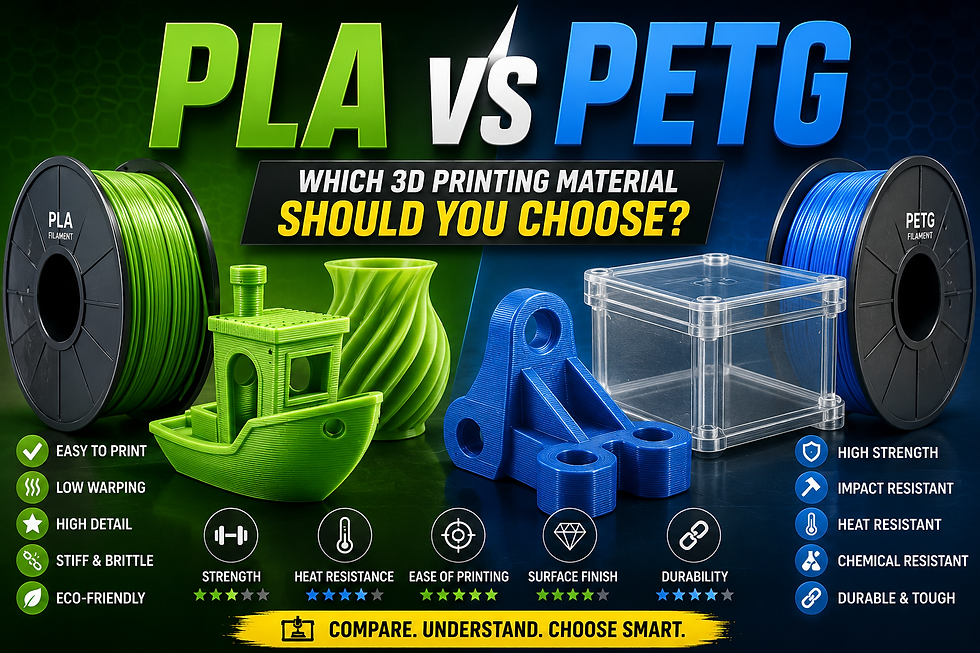
Understanding strength, durability, printability, thermal resistance, and real-world engineering applications.
Introduction
Choosing the correct material is one of the most important decisions in any 3D printing project. A well-designed part can still fail if the material does not match the mechanical, thermal, or environmental requirements of the application.
Among desktop FDM 3D printing materials, PLA and PETG are two of the most widely used filaments due to their affordability, accessibility, and versatility. However, they are designed for very different use cases.
PLA is known for excellent print quality and ease of use, while PETG offers higher toughness, improved thermal resistance, and better long-term durability.
This guide explores the differences between PLA and PETG in detail, including:
Mechanical properties
Thermal performance
Chemical resistance
Printability
Surface finish
Layer adhesion
Engineering applications
Recommended print settings
Material selection for real-world products
What is PLA?
PLA (Polylactic Acid) is a biodegradable thermoplastic commonly derived from renewable resources such as corn starch or sugarcane.
It is one of the easiest materials to print and is widely used for: Rapid prototyping, Visual models, educational projects, Consumer products, Decorative components, Low-load mechanical parts.
Key Characteristics of PLA
Low warping tendency
Excellent dimensional accuracy
Smooth surface finish
Minimal shrinkage
Easy to print on most printers
Available in many colors and finishes
Environmentally friendlier than petroleum-based plastics
Limitations of PLA
Heat resistance
Impact resistance
Long-term outdoor durability
Structural flexibility
What is PETG?
PETG (Polyethylene Terephthalate Glycol-modified) is an engineering-grade thermoplastic that combines strength, flexibility, and chemical resistance.
PETG is widely used for: Functional mechanical parts, Industrial enclosures, Mounting brackets, electronic housings, Outdoor applications, Water-resistant components, Protective covers
Compared to PLA, PETG is tougher, more temperature resistant, and less brittle.
Key Characteristics of PETG
High impact resistance
Excellent layer adhesion
Good chemical resistance
Better thermal stability
Semi-flexible behavior
Moisture resistance
Durable under repeated loading
Limitations of PETG
Increased stringing
More difficult tuning
Reduced surface sharpness
Higher sensitivity to moisture during printing
Mechanical Properties Comparison
Tensile Strength
PLA generally has higher tensile strength than PETG in static loading conditions.
Typical values:
Property | PLA | PETG |
Tensile Strength | 50–65 MPa | 45–55 MPa |
Young’s Modulus | High stiffness | Moderate stiffness |
Flexibility | Low | Medium |
Impact Resistance | Low | High |
Impact Resistance
PLA
Brittle under sudden loading
Can crack when dropped
Poor shock absorption
PETG
Excellent toughness
Better vibration resistance
Suitable for moving or load-bearing assemblies
For engineering applications exposed to vibration or repeated handling, PETG is usually the safer option.
Heat Resistance
One of PLA’s major limitations is low thermal resistance.
Property | PLA | PETG |
Glass Transition Temperature | ~60°C | ~80°C |
Heat Resistance | Low | Moderate |
PLA Heat Performance
PLA can soften inside:
Cars during summer
Near motors
Around electronics
Under sunlight exposure
PETG Heat Performance
PETG performs significantly better in elevated temperatures and is more suitable for:
Automotive interiors
Electronics enclosures
LED housings
Industrial covers
Chemical and Moisture Resistance
PLA
PLA is more sensitive to: Moisture over time, UV degradation, Chemical exposure
Not recommended for prolonged outdoor exposure.
PETG
PETG offers superior resistance against: Water, Oils, Cleaning chemicals, Mild acids
Better suited for: Outdoor sensor housings, Industrial cover, Garden equipment, Utility parts
Printability Comparison
PLA Printing Advantages
PLA is considered the easiest filament for beginners because it:
Prints at lower temperatures
Requires minimal cooling adjustments
Produces less warping
Works on most print surfaces
Maintains excellent detail quality
Typical PLA Parameters
Setting | Typical Range |
Nozzle Temperature | 190–220°C |
Bed Temperature | 0–60°C |
Print Speed | 40–120 mm/s |
Cooling Fan | High |
Enclosure | Not required |
PETG Printing Advantages and Challenges
PETG requires more tuning but produces stronger functional parts.
Typical PETG Parameters
Setting | Typical Range |
Nozzle Temperature | 220–260°C |
Bed Temperature | 70–90°C |
Print Speed | 30–80 mm/s |
Cooling Fan | Medium |
Enclosure | Optional |
Common PETG Challenges
Stringing
Oozing
Excessive bed adhesion
Surface blobs
Moisture absorption
However, once optimized, PETG delivers highly durable parts.
Surface Finish and Appearance
PLA generally produces:
Sharper details
Cleaner overhangs
Better aesthetic surfaces
Matte or glossy finishes
PETG surfaces are typically:
Slightly glossier
Softer in detail
More prone to visible strings
Dimensional Accuracy
PLA usually offers:
Better dimensional consistency
Less shrinkage
Higher geometric precision
PETG can sometimes produce:
Slight expansion
Softer corners
Reduced sharp-edge accuracy
For precision-fit assemblies, PLA may be easier to tune.
Applications
PLA
PLA is ideal for:
Visual prototypes
Concept validation
Educational projects
Decorative parts
Product showcases
Low-temperature indoor applications
High-detail models
Examples: Presentation prototypes, Architectural models, Consumer product mockups, Display enclosures, Marketing samples
PETG
PETG is ideal for:
Functional engineering parts
Electronics housings
Mechanical brackets
Outdoor components
Industrial fixtures
Protective covers
Load-bearing assemblies
Examples: Raspberry Pi enclosure, Sensor housings, Drone accessories, Automotive mounts, Industrial tool holders
Which Material is Better for Engineering Projects?
The answer depends entirely on the application.
Choose PLA When:
Visual quality matters most
Printing speed is important
The part is mainly aesthetic
High precision is required
Temperature exposure is low
Choose PETG When:
Strength and durability matter
Parts experience mechanical stress
Outdoor use is expected
Heat resistance is needed
Impact resistance is critical
PLA vs PETG: Final Comparison
Feature | PLA | PETG |
Ease of Printing | Excellent | Moderate |
Strength | High stiffness | High toughness |
Flexibility | Low | Medium |
Heat Resistance | Low | Better |
Chemical Resistance | Low | Good |
Surface Finish | Excellent | Good |
Outdoor Durability | Poor | Better |
Impact Resistance | Poor | Excellent |
Layer Adhesion | Good | Excellent |
Beginner Friendly | Very High | Medium |


Comments