Shaping Innovation
- IoT Hardware, Product Development
From PCB to Product:
Portable Industrial Data Logger
Most hardware startups hit the same wall: the electronics work, the firmware runs — but translating a validated PCB into a manufacturable, market-ready product is an entirely different problem. This project documents exactly how that gap gets closed.
CATEGORY
IoT/Embedded Software
DELIVERABLES
Enclosure - Prototype
01 - PROBLEM
Electronics are the easy part
Environmental monitoring is a solved problem at the circuit level. BME280 sensors, ESP32 microcontrollers, LiPo charging circuits — the components exist, they're cheap, they work. The hard problem is everything that happens next: how do you package those components into something a human can hold, a factory can assemble, and a supply chain can reproduce at scale?
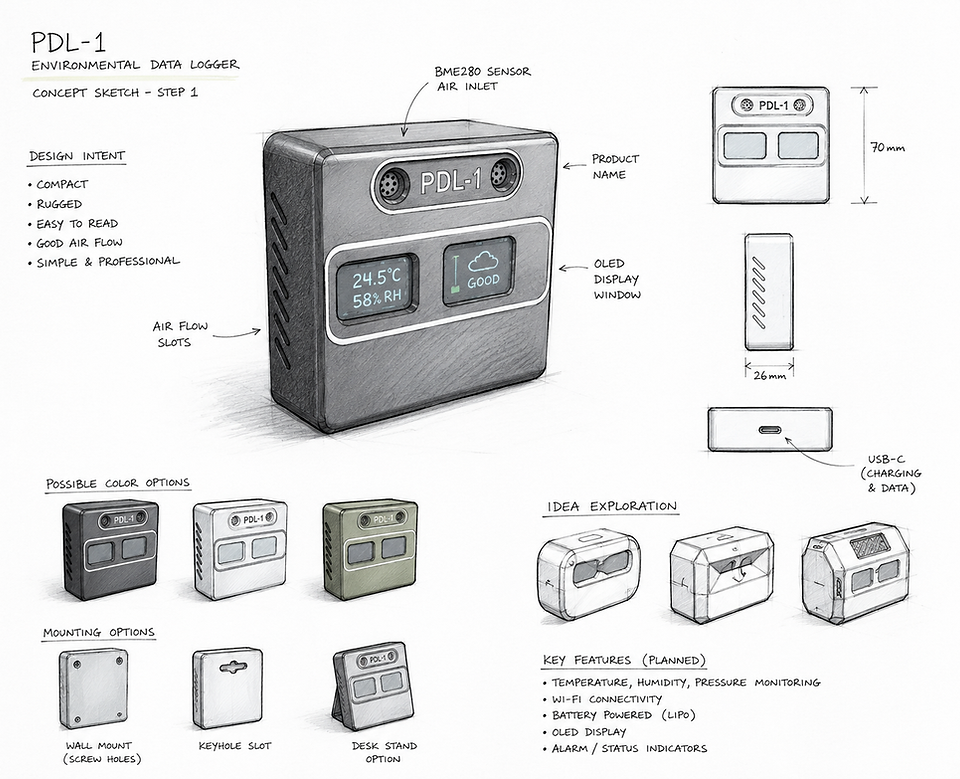
The PDL-1 project was built to answer that question end-to-end. The brief was deliberately constrained: a battery-powered IoT logger measuring temperature, humidity, and pressure — using off-the-shelf modules, a compact two-part enclosure, and a functional prototype that could be handed to a manufacturer as a starting point for tooling.
"The real challenge wasn't fitting three boards into one shell. It was giving each board its own standoff height, its own clearance, and its own access point — without turning the enclosure into a maze."
That single conflict between sensor exposure and component protection drove most of the mechanical decisions that followed.
02 - PRODUCT ARCHITECTURE
Defining what goes inside before designing the outside
Before any geometry was sketched, the internal architecture had to be fixed. Component selection directly constrains enclosure geometry — a decision made in the BOM shows up as a wall thickness, a keep-out zone, or a snap-fit tolerance three weeks later.
The ESP32-S3 Feather was chosen because its integrated charging circuitry removes the need for a separate power management board — eliminating one PCB, reducing internal height by roughly 4mm, and simplifying cable routing. These are the kinds of decisions that only matter once you're designing an enclosure around them.
Hardware Specifications
03 - COVER DESIGN AND SEALING
Brass inserts and a pressure-equalising membrane
The cover does more than close the enclosure — it carries the hardware that holds the whole assembly together and manages environmental sealing for the sensor. Four threaded brass inserts are inserted (Heat insertion) into the cover to receive the assembly screws, and the enclosure houses with a pressure membrane that lets the internal sensor (BME280) read true ambient pressure without exposing the electronics to moisture or dust.
That single conflict between sensor exposure and component protection drove most of the mechanical decisions that followed.
_edited.png)
_edited.png)
04 - BODY DESIGN
Designing the plastics around the stack
With the cover's sealing strategy fixed, the body was developed around the actual standoff heights and cable paths required by the four-board layout. Every post in the body has a defined job: some carry screw bosses for the M2.2 PCB screws, some are pure structural standoffs, and others double as alignment guides during assembly.
The rounded cutout on the side wall lines up with the USB-C connector on the main board, and the body's outer profile carries the four corner bosses that receive the inserts from the cover.

05 - KEY DECISIONS & TRADE-OFFS
The choices that shaped the product
Every mechanical design is a negotiation between competing constraints. Here are the decisions that most directly shaped this enclosure:
06 - RESULTS
A serviceable, sealed, multi-board enclosure
The PDL-1 project delivered a complete mechanical package built around a real four-board stack: a body with individually-sized standoffs and cable routing, and a cover combining structural screw bosses with a dedicated, sealed pressure-sensing window.
Final deliverables included the full body and cover CAD models, a defined hardware BOM covering inserts, membrane, and fastener part numbers, and a structure ready to be carried into prototype manufacturing.

07 - CONCEPTUAL MONITORING PLATFORM
To support evaluation of the PDL-1 concept, a prototype monitoring interface was developed to visualize environmental data collected by the device. The platform demonstrates how temperature, humidity, atmospheric pressure, battery status, and alarm conditions can be presented through a centralized dashboard. Features include historical trend visualization, device status monitoring, report generation, and a location-based map view for identifying active and offline devices. The interface was developed as a proof-of-concept to validate the overall user experience and system architecture of a connected environmental monitoring solution.